Imposing Order on Lingerly Place
Or not?

It has been a few weeks since I have written on Substack. The month of May was a whirlwind followed by a two-week trip in June to Naples and Rome. My laptop was left behind. I absorbed a lot during that time—images, thoughts, experiences. Now I am home, my laptop open before me, my calendar empty. I am ready to resume my writing practice.
An Orderly Substack
As I settle back into Lingerly Place, my mind is full and restless.
The second part of the “Ashes and Pulp” reflection, started a week after Mother’s Day, awaits completion. The “Noticing” series referenced in an earlier post hasn’t materialized beyond two essays. The early momentum of diarizing my days leading up to and following early retirement has dwindled. Yet, I recovered pre-Substack writing that I am now eager to share while reducing my storage load on my former institution’s server. I take another look at my Substack profile—it seems undeveloped. I wonder:
Is it time to impose order on Lingerly Place?
According to the writing advice replete on the Substack feed, the answer is yes. To summarize one author, writers are urged to master the system, which is as important as compelling content.
Post consistently on a regular schedule.
Find a “niche” that resonates with your audience.
Stay engaged with a mix of content formats (notes, short articles, podcasts).
Be strategic. Create your brand. Grow your subscribers. Increase open rates.
This advice is familiar to me. I spent a long time as an administrator and those years have socialized me to the practice of leveraging systems to achieve outcomes. The Substack platform is a useful and productive one, but it is still a media platform with built in distractions. I can master the system, but will this mastery create meaning? More precisely, mastery of the system at what cost to the making of meaning?
I can’t help but seek coherence in what I am putting together. Perhaps the creative drive, at its origins, is a longing for a satisfying answer, an interpretation that brings form to the chaos, the explanation that makes sense out of nonsense. Logical and efficient design: it can help to reign in the disorder. But I think that for now and for me, the disorder is necessary.
A Disorderly Process
When I was much younger, I kept sketchbooks. I still have one that someone had given me about forty years ago—a beautiful, double-sided, accordion style book.
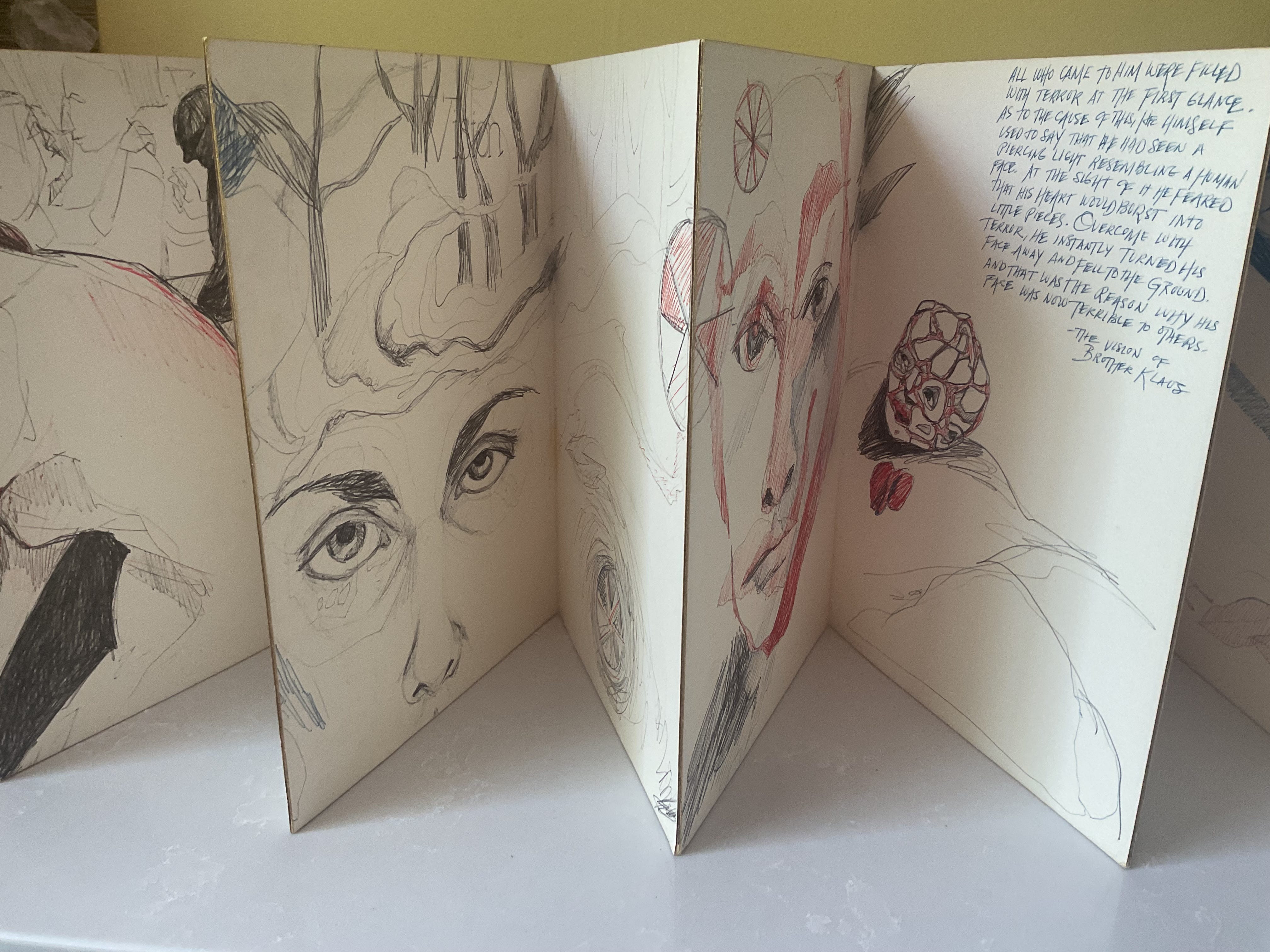
The book was a private space to draw and write and curate quotes or images that were significant to me. I was at a threshold point in my life, a time when I was interrogating long-held beliefs and traditions, attempting to find my place in the world as an embodied being with desires, testing limits that had once seemed sacrosanct. There are drawings of faces and bodies, pomegranates, and trees, as well as quotes from Iris Murdoch (Nuns and Soldiers) and Hermann Hesse (The Magister Ludi), and a photo of one of Andrew Wyeth’s Helga paintings. Across two pages was a poem of sorts recounting a conversation I had with other young, Catholic women:
A new generation is rising up from the underground—a white pomegranate generation bursting with blood red seeds. How sincerely frightened Susan was to admit that she questioned whether the divinity is really so. And, yet we all agreed with her boldness. How free we felt, though nervous. If this is so, who are we then?
More pages of theological musings, and then, the words Sit with It written below a sketch of a half-naked figure in zazen, followed by another sketch of a hand reaching into an arc of darkness.
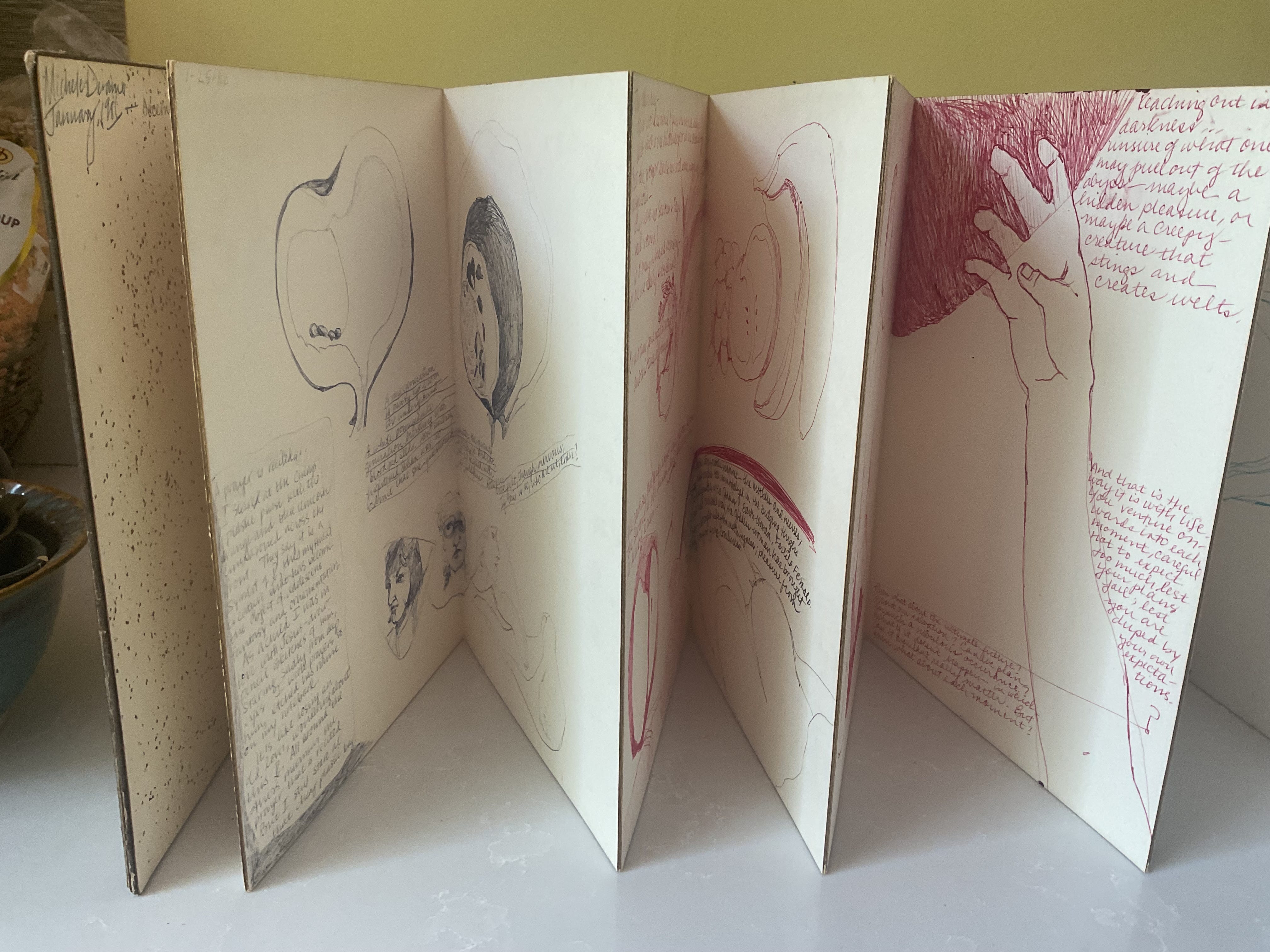
The sketchbook was filled at random, until the pages were filled, with the final words on the final page: 2 years have passed. There was no intention to the sequencing of pages, from one to the next, yet, as I review it now with the vantage of time and age, I can see the coherency woven through it. Across the quotes and drawings and meandering reflections there was a story.
I remember that time as one of disorder and turmoil. I remember, as well, how good it felt to leave that time behind, to enter stages of life where I was organized and well-bounded, competent and restrained. A perfect administrator.
I no longer kept sketchbooks after leaving that time behind.
A Return
After raising this question to myself of imposing order on Lingerly Place, and wondering if the way I described my efforts on this Substack was still relevant, I decided to reread one of my first posts, Why Lingerly Place? I was reminded that my purpose was to establish for myself a “nowhere place” where I could create without purpose or intent. I was leaving behind a different stage of life—in fact, multiple life stages all of which had in common the objectives of raising a family and making a living. As I continued writing toward greater clarity, I remembered my accordion sketchbook—one of the only to remain after years of sketch booking—setting on a shelf alongside my Ferrante books. The presence of the sketchbook, its placement on the shelf, its materiality in my hands, the memory of losing time in thought and expression: it was a coalescence of meaning.
I return to the disorderly process, because the process itself brings order into being. What is not apparent when we are immersed in the process—eventually emerges.